The Future of Work Is Human
Artificial Intelligence, the Next Generation, and What Four Decades in Real Estate Have Taught Me
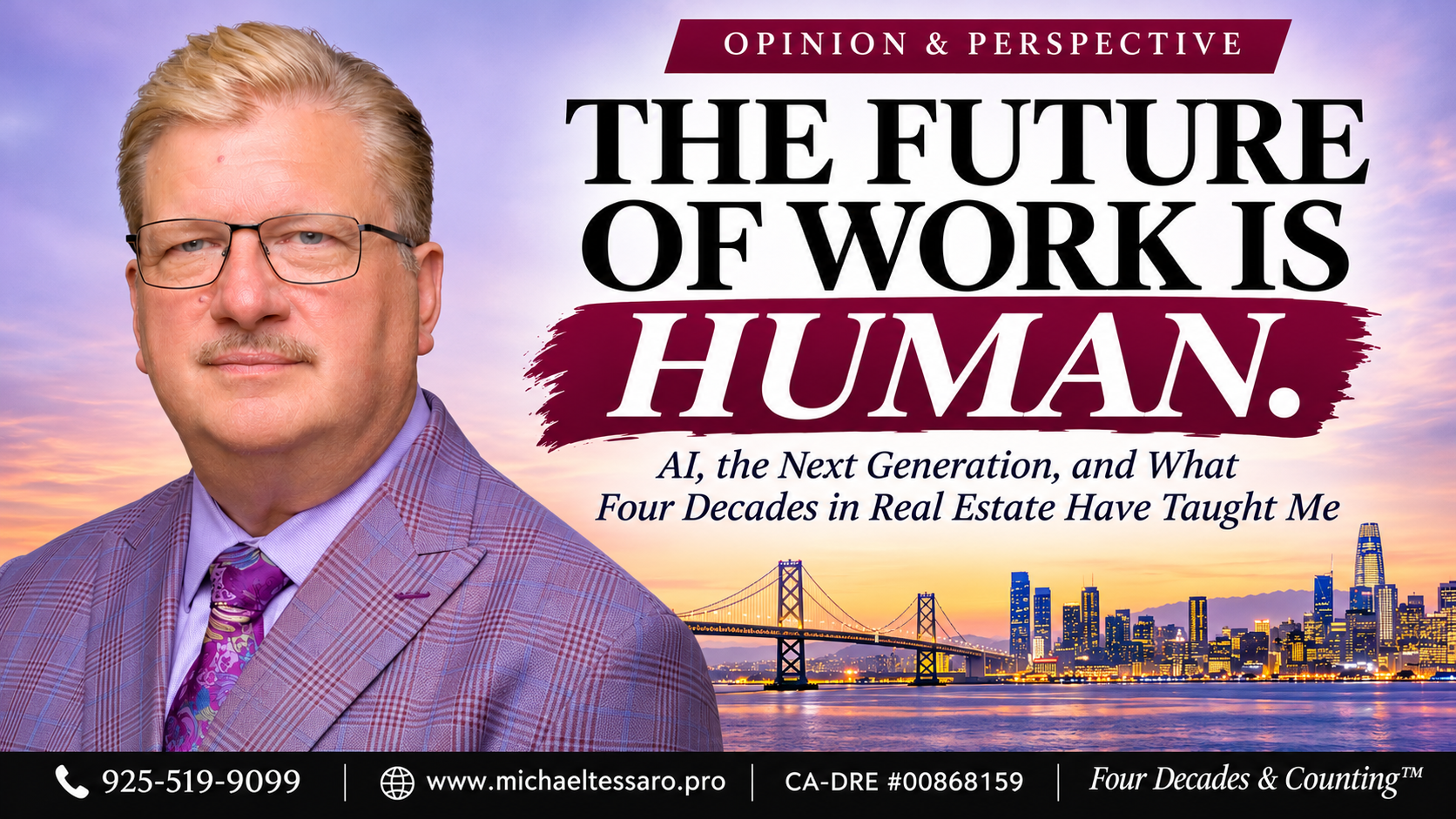
I recently came across an interview with Dario Amodei, the CEO of Anthropic, the company behind Claude AI. He was asked what advice he would give a young person finishing high school and preparing to enter a world where artificial intelligence is changing practically everything. It was an interesting question, and his response got me thinking about how much the world has changed during my own working life, particularly in real estate.
Amodei has been quite outspoken about the potential disruption AI could bring to the workforce. He's warned that many entry-level white-collar jobs could disappear or change substantially over the next several years. He's also emphasized the importance of critical thinking and developing skills that remain valuable as technology advances. Whether his predictions prove accurate is something we'll have to wait and see, but I think the larger conversation is one we should all be having, regardless of our age or profession.
I started my real estate career at 19 in July 1984. Looking back, it's almost difficult to explain to someone entering the business today just how different things were. We didn't have the internet, smartphones, electronic signatures, online property searches, or instant access to comparable sales. We had printed listing books, landline telephones, paper contracts, and a lot of time spent driving around looking at properties. If you wanted information about a home, you generally called the listing agent, visited the property, or went looking through records. The process was considerably more labor-intensive than it is today, but it also required us to develop relationships, communicate effectively, and learn our markets firsthand.
Over the years, I've watched one technological advancement after another change the way we conduct business. When property listings became widely available online, there were predictions that real estate agents would become obsolete. Then came automated property valuations, virtual tours, digital marketing, electronic contracts, and all the other conveniences we now take for granted. Each advancement changed some part of our business, and each required us to adapt. Some agents embraced those changes, while others resisted them. I think we're seeing something similar with artificial intelligence today, although the speed and scope of this particular transformation may be considerably greater.
What concerns me isn't necessarily that AI will replace every professional. I don't believe that's a foregone conclusion. What concerns me is that people may begin confusing access to information with the ability to understand and properly apply it. There's an enormous difference between generating an answer and knowing whether that answer makes sense. I've seen AI produce impressive work in seconds, and I've also seen it confidently provide information that was completely wrong. If the person using the technology doesn't have the knowledge or experience to recognize the difference, that can become a serious problem.
This is particularly relevant in real estate, where decisions often involve substantial financial consequences and deeply personal circumstances. An automated valuation might estimate what a property is worth, but it doesn't necessarily understand the condition of that particular home, the motivations of the people involved, or the circumstances that could influence a transaction. AI can analyze market statistics, prepare marketing materials, summarize documents, and help organize complicated information. Those are valuable capabilities, and I use them myself. But there's still a difference between producing information and providing thoughtful professional guidance.
I've worked with homeowners who were trying to decide whether to sell a property they'd lived in for 30 or 40 years. Sometimes they're preparing for retirement. Sometimes they've inherited a home after losing a parent. Other times they're dealing with divorce, financial changes, health-related circumstances, or the difficult realization that their home no longer meets their needs. Those conversations aren't simply about square footage, comparable sales, or what the market might bear. They're about people, their families, their memories, and what comes next in their lives.
I've also had conversations where I believed the homeowner would be better served by staying in the property rather than selling it. Perhaps remodeling would make more sense, or perhaps the timing simply wasn't right. That's not always the answer someone expects from a real estate agent, but I've never believed our responsibility begins and ends with getting a property listed and sold. Sometimes the most valuable advice we can give someone is to help them understand why they shouldn't make a particular move.
Could artificial intelligence help a homeowner evaluate those choices? Absolutely. In fact, I think it can become an extremely useful resource for consumers who want to better understand their options before making a decision. But I wouldn't want anyone making a major financial or personal decision based entirely on an automated response without understanding the assumptions behind it or consulting the appropriate professionals.
I also believe those of us in real estate need to be realistic about what AI means for our own profession. If an agent's primary value is providing information that consumers can now obtain themselves, that agent is going to have a difficult time justifying their role. The same applies to professionals in many other industries. Technology is making certain tasks easier, faster, and less expensive, and consumers have every reason to expect those efficiencies to benefit them.
That doesn't mean experience has lost its value. I would argue that experience becomes particularly important when information is abundant but not always reliable. Knowing how to interpret market conditions, recognize potential problems, negotiate effectively, and help someone understand the consequences of different decisions requires more than generating a report. It requires knowledge, judgment, and accountability. And those are qualities that professionals must continue developing rather than assuming their years in business automatically make them indispensable.
Which brings me back to that high school graduate.
If a young person asked me today what they should study or what career they should pursue, I don't think I'd begin by telling them to become a programmer, an engineer, an attorney, or even a real estate agent. I'd want to know what interests them, what they're good at, and what kind of problems they enjoy solving. I'd encourage them to learn how to use AI, because I suspect it will become as commonplace in the workplace as computers and smartphones are today. But I'd also encourage them to develop the ability to think independently, communicate clearly, understand finances, work with different personalities, and recognize when something doesn't seem right.
I still believe there's tremendous value in a college education, but I don't believe college is the only path to a successful and fulfilling career. Skilled trades, technical education, apprenticeships, entrepreneurship, and other forms of hands-on training deserve serious consideration. Not everyone is suited to the same path, and there's nothing wrong with that. What's important is developing useful skills, learning how to solve real problems, and remaining willing to adapt as opportunities change.
One thing I've learned from working since I was young is that education doesn't stop when you receive a diploma or earn a professional designation. Some of the most valuable lessons I've learned came from difficult transactions, unexpected challenges, mistakes, and conversations with people who had experiences very different from my own. There isn't a textbook or software program that can fully substitute for those experiences. Technology can help us learn, but we still have to be willing to do the learning.
And this conversation shouldn't be limited to people who are 18 or 22 years old. Someone who's 45, 55, or 65 may be facing the same questions about how to remain relevant in a changing workplace. I've been in real estate for more than 42 years, and I'm still learning new systems, evaluating new technology, and reconsidering how certain parts of my business should operate. Some of those changes are exciting, and others can be downright frustrating. I certainly don't embrace every new product simply because someone attaches the letters AI to it. But I also recognize that refusing to learn something new isn't going to stop the world from changing.
Living and working in the San Francisco Bay Area and Silicon Valley gives us a particularly interesting perspective on all of this. We're surrounded by companies and people developing technologies that could influence employment, business investment, household wealth, and the broader economy. Those changes may also affect our local housing markets as people reconsider where they work, how much they earn, whether they can afford to purchase a home, or whether they should remain in the property they already own.
I wouldn't suggest that every announcement from an AI company will immediately affect home prices. Real estate markets are far more complicated than that. Interest rates, housing inventory, affordability, local employment, and individual household circumstances all play important roles. Still, I believe technological change is becoming another consideration for homeowners who are thinking about retirement, relocation, downsizing, or making a significant financial commitment.
There's also a broader question that I think deserves attention. As artificial intelligence becomes capable of performing more of the work we once did ourselves, are we going to use the time and resources it saves to become better at what we do, or are we simply going to become more dependent on the technology? I don't have a definitive answer, but I think it's something worth considering. Convenience is wonderful, and efficiency matters, but neither should come at the expense of our ability to think critically or take responsibility for our decisions.
I don't pretend to know what the workforce will look like ten years from now. I don't think anyone does, including the people building these systems. There will undoubtedly be opportunities we haven't imagined, and there may be difficult disruptions along the way. I also think we need to be careful about accepting every prediction from technology executives as though the future has already been decided. Their perspectives are worth listening to, but they're still predictions.
What I do believe is that people who remain curious, continue learning, develop sound judgment, and understand how to work with others will be better prepared to navigate whatever comes next. That applies to someone graduating from high school this spring just as much as it applies to someone who has spent decades building a career.
When I think about the changes I've witnessed since 1984, I'm grateful for many of the tools we have today. They allow me to accomplish things that would have taken considerably more time and effort earlier in my career. But I also appreciate the lessons that came from doing things the old-fashioned way, particularly the importance of listening, building trust, and understanding that every client has a different story.
Artificial intelligence will continue to change how we work, and I intend to continue learning how to use it effectively. But I don't want technology to replace the personal responsibility that comes with giving someone advice, especially when that advice could affect their home, their finances, or their family's future.
After more than four decades in real estate, I still believe the most important part of any business is understanding the people you're serving. The technology will continue to evolve, and so will the way we use it. I just hope that as we become more technologically capable, we don't forget the value of being human.
That's my perspective, and it's one I expect to keep examining as the world continues to change.
Questions Readers Are Asking
Will artificial intelligence replace real estate agents?
Artificial intelligence is already changing how real estate professionals research properties, analyze market conditions, prepare marketing materials, and communicate with clients. However, buying or selling a home often involves complicated financial and personal decisions. I believe experienced professionals who combine technology with sound judgment, negotiation skills, and personal accountability will continue to provide meaningful value.
What should high school graduates study in the age of AI?
There isn't one career or educational path that makes sense for everyone. I would encourage young people to develop critical thinking, communication, financial literacy, and problem-solving skills while learning to use artificial intelligence effectively. College, technical education, apprenticeships, and entrepreneurship can all offer worthwhile opportunities depending on someone's interests and goals.
Will AI affect home values in Silicon Valley and the San Francisco Bay Area?
Artificial intelligence could influence local housing markets through changes in employment, household income, stock compensation, and business investment. However, property values also depend on interest rates, housing inventory, affordability, and neighborhood conditions. No single technology development determines the direction of an entire housing market.
Can homeowners use AI to decide whether to sell, stay, remodel, or relocate?
AI can help homeowners research property values, compare housing options, and organize questions about their financial circumstances. But those results should be evaluated carefully. A decision involving retirement, an inherited property, downsizing, or a major life transition may require guidance from experienced real estate, financial, tax, or legal professionals.
What skills will remain valuable as artificial intelligence advances?
I believe the ability to think independently, communicate effectively, exercise sound judgment, build relationships, and take responsibility for decisions will remain important. Technology can make us more efficient, but knowing how to interpret information and apply it responsibly is a different skill altogether.
Explore homeowner life-transition resources · Back to the Journal
About the Author
Michael Tessaro began his real estate career at age 19 in 1984 and has spent more than four decades serving homeowners throughout the San Francisco Bay Area, Silicon Valley, and surrounding communities. A REALTOR®-Emeritus with Intero Real Estate Services, he specializes in helping homeowners navigate significant life transitions, including downsizing, inherited properties, trusts and estates, remodeling decisions, and relocation.
Michael Tessaro, REALTOR®-Emeritus
San Francisco Bay Area & Silicon Valley Life Transition Specialist
Intero Real Estate Services · 925-519-9099 · michaeltessaro.pro
CA-DRE #00868159 · Four Decades & Counting™
Editorial Disclaimer: This article reflects the personal opinions and professional observations of Michael Tessaro and does not represent the official positions of Intero Real Estate Services, the Bay East Association of REALTORS®, the California Association of REALTORS®, or the National Association of REALTORS®. Commentary concerning artificial intelligence, employment, and economic trends is provided for general informational purposes and should not be interpreted as a prediction of specific outcomes or as legal, tax, financial, or investment advice.